
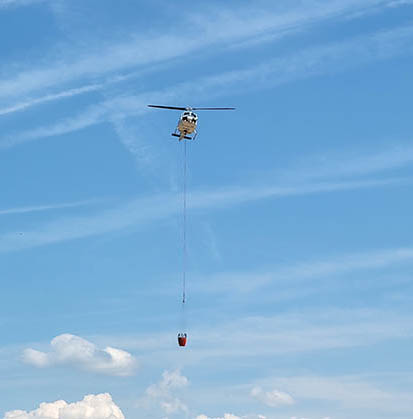


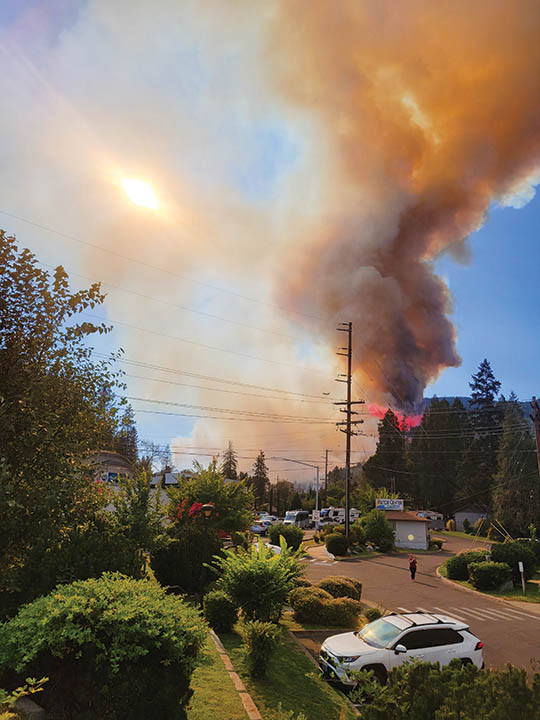
A cargo truck that stopped to tend to its hot brakes and caught vegetation on fire at Milepost 51 on Interstate 5 in the afternoon on Thurs., Aug. 13, was the reported cause of the Fielder Mountain Fire that immediately caused road closures and a Level 3 “Go now” evacuation in west Rogue River over the weekend.
By Mon., Aug. 17, the fire had reached its peak of 573 acres, with an effort led by the Oregon Department of Forestry (ODF) Complex Incident Management Team 1, including 22 hand crews, 10 aircraft, and 27 fire engines, and establishing a line around the fire by Sat., Aug. 15.
The impact of the fire was felt immediately, with traffic on Interstate 5 interrupted and displaced onto Rogue River Highway and the Depot Street Bridge. Electricity was shut off to businesses south of the Rogue River to enable the early air assault on the fire the afternoon of Aug. 13.
“They can’t drop water on charged lines,” Kelly Foster, a forester for ODF. Foster was helping coordinate an air incident command in the lower fields of the Martin property in Wimer in the afternoon on Aug. 14.
“That’s a watchout situation,” Foster said, describing the conditions at the fire’s outset on Aug. 13. “That’s the first thing the air attack platform was asking dispatch, to coordinate with the power company to get the transformers turned off. Once dispatch turns the transformers off, then we can start fighting the fire. And that happened, the timing was pretty quick.”

The fuel, along with the dry vegetation on the hills between Rogue River and Grants Pass, was the hot conditions and low humidity of an August afternoon with persistent and shifting winds.
“We call it ‘The Witching Hours’ in the afternoon for the Rogue Valley,” Foster said. “It’s about 2 to about 6 in the afternoon, because that’s when you get that local wind, the heat of the day, and that’s when we’re in the heart of fire season right now. It’s extreme. It’s all hands on deck. You’re just waiting and listening for that tone (on the radio), and we’re figuring out where the fire’s at.
“Rogue River’s right in the middle, so a lot of times, you’re getting folks from Medford and Grants Pass responding, and that’s what happened with this Fielder Mountain Fire.”
Level 3 “Go now” evacuation levels were in place for Foothill Boulevard and West Evans Creek Road, nearly to Fielder Creek Road, about four miles north of Rogue River. The evacuation orders were lifted by the morning of Mon., Aug. 17.
Rogue River Public Works Director Michael Bollweg asked Rogue River citizens to limit their water use through the weekend to free up more water for firefighting.
The fire grew to 75 acres by 5 p.m. on Aug. 13 and then to 450 acres by 11:30 p.m. that night.
The air incident command team approached the Martin family through Lawrence Martin because the property’s lower field is large enough to safely provide takeoff and landing space for Type I, Type II, and Type III helicopters.

“Type 1s are your big helicopters, and they can go even bigger, like a Sky Crane or a heli tanker. It just so happens (these are) Blackhawks. They’ve got to have at least an 800-gallon bucket or bigger to be considered in that Type 1,” Foster said. “Anything less than 800 gallons is a Type II, and then we get into our Type III, which are usually used as helitack or air attack platforms. And they can carry crew members. They can carry an air attack to manage the airspace, or they can do a little bucket work.”
The helicopter, or ship, as they’re called, flies above the firefighting area, directing traffic.
“The point of this helicopter with no bucket is that it goes on top of the stack, or the air, and it manages the air space,” Foster said. “So it’s on top of the stack and tells the tankers what to do, tells the rotors what to do, and how to do it, and keeps them separated so that there’s safe operation.”
Foster pointed out Jordan, a pilot who had flown her ship from Spray, in Central Oregon. She was on her way to the Grants Pass Airport for fuel because her ship’s fuel truck wouldn’t be due in Wimer until 7 p.m.
When Jordan eventually took off to assist the Fielder Mountain effort, she would have the air attack specialist up front with her as she piloted the ship.
“That air attack, they’re ordering the world,” Foster said. “They’re able to get air tankers, too, but the helicopters saved the day (Aug. 13, immediately after the fire started).

Two helicopters were landing in the field in the afternoon on Aug. 14 at close to the same time.
“This other ship is coming in,” he said, after one had landed. “That buildup. That’s what I don’t like, that buildup.”
When the second one landed, he said, “That could be yours for $10 million.”
Pilots are allowed to be in the air for no more than 8 hours a day and must take a break after several days in the air.
The Fielder Mountain Fire might have reminded residents of the rapid response to a wind-driven blaze on Boise Cascade land on Fielder Mountain 30 years ago, on Aug. 20, 1996, a fire that was limited to just under 20 acres, and, more recently, the spark of the 565-acre North River Road Fire east of the city on Aug. 19, 2011. In that fire, which also started from vehicle sparks, no homes were lost, and no mandatory evacuations were called for.
Reach reporter Brian Mortensen at [email protected] or 541-582-1707.
