
News

Oregon National Guard Tests Drone To Improve Battlefield Safety

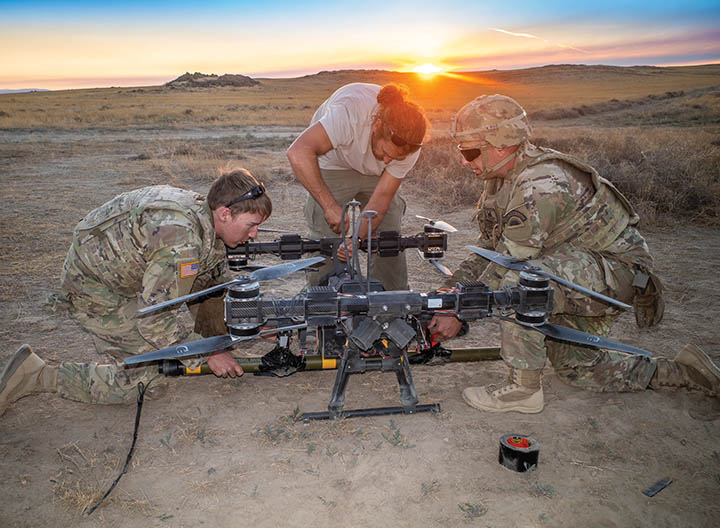
From left, Capt. Samuel Cushing, plans officer for the 741st Brigade Engineer Battalion, Austin Hansen, director of manufacturing for Lorica Technologies Inc., and 1st Lt. Andrew Lucas, of the battalion’s S-3 section, work together to attach a live M1A3 Bangalore torpedo to a Lorica Mule 28 unmanned aerial system before a proof-of-concept drone-delivered breach June 22, 2026, on Range 22 at Orchard Combat Training Center, Idaho. Hansen conducted preflight checks while Cushing and Lucas rigged the demolition charge for the final attempt. Soldiers with Bravo Company, 741st Brigade Engineer Battalion, 41st Infantry Brigade Combat Team, conducted the drone-delivered breach as the culmination of months of planning by the battalion’s drone working group. (U.S. Army National Guard photo by Maj. W. Chris Clyne, Oregon National Guard Public Affairs)

Oregon Army National Guard Soldiers recently demonstrated a new use for drone technology that could make one of the military’s most hazardous engineering missions significantly safer.

During annual training on June 22, Soldiers from Bravo Company, 741st Brigade Engineer Battalion, 41st Infantry Brigade Combat Team successfully used a heavy-lift drone to deliver and detonate a live Bangalore torpedo through a wire obstacle from a safe distance.

Combat engineers are responsible for clearing obstacles such as concertina wire and minefields so troops can advance. Traditionally, placing explosive charges requires Soldiers to move dangerously close to enemy positions. The drone demonstration showed how explosives can instead be delivered remotely, allowing engineers to remain under cover while creating a path through the obstacle.

The project was developed over several months by the battalion’s drone working group under the leadership of battalion commander Lt. Col. Eric Zimmerman. The unit partnered with Ashland-based Lorica Technologies, which supplied the heavy-lift unmanned aircraft used during the test.

Zimmerman said the effort reflects the Oregon Army National Guard’s commitment to innovation and adapting to lessons learned from modern conflicts.

“Watching what’s happening in Ukraine and seeing how innovative they’ve been inspires you to get better and think bigger,” Zimmerman said.

Before using live explosives, Soldiers conducted a series of increasingly complex tests with inert training devices. The final demonstration successfully delivered and detonated a two-section Bangalore torpedo, clearing a lane through the wire obstacle.

Zimmerman credited the success to collaboration between battalion leadership and the Soldiers responsible for carrying out the mission.

“I’m really proud,” he said. “The Soldiers of Bravo Company took an idea from the battalion staff and applied their expertise to make that idea functional and effective.”

Military leaders say the demonstration highlights how partnerships with Oregon’s technology industry can help develop new tactics and improve battlefield capabilities. Information gathered during the project will be used to guide future Army engineer training and expand the use of unmanned aircraft systems in combat operations.

The Oregon Army National Guard is made up of citizen-Soldiers who balance military service with civilian careers, education and family life. In addition to federal deployments, Guard members remain ready to assist Oregon communities during emergencies such as wildfires, floods, winter storms and other natural disasters.

Reach Publisher Teresa Pearson at [email protected].